Trending




Current Read





Enter your email address below and subscribe to our newsletter

A Symphony of Memory and Change

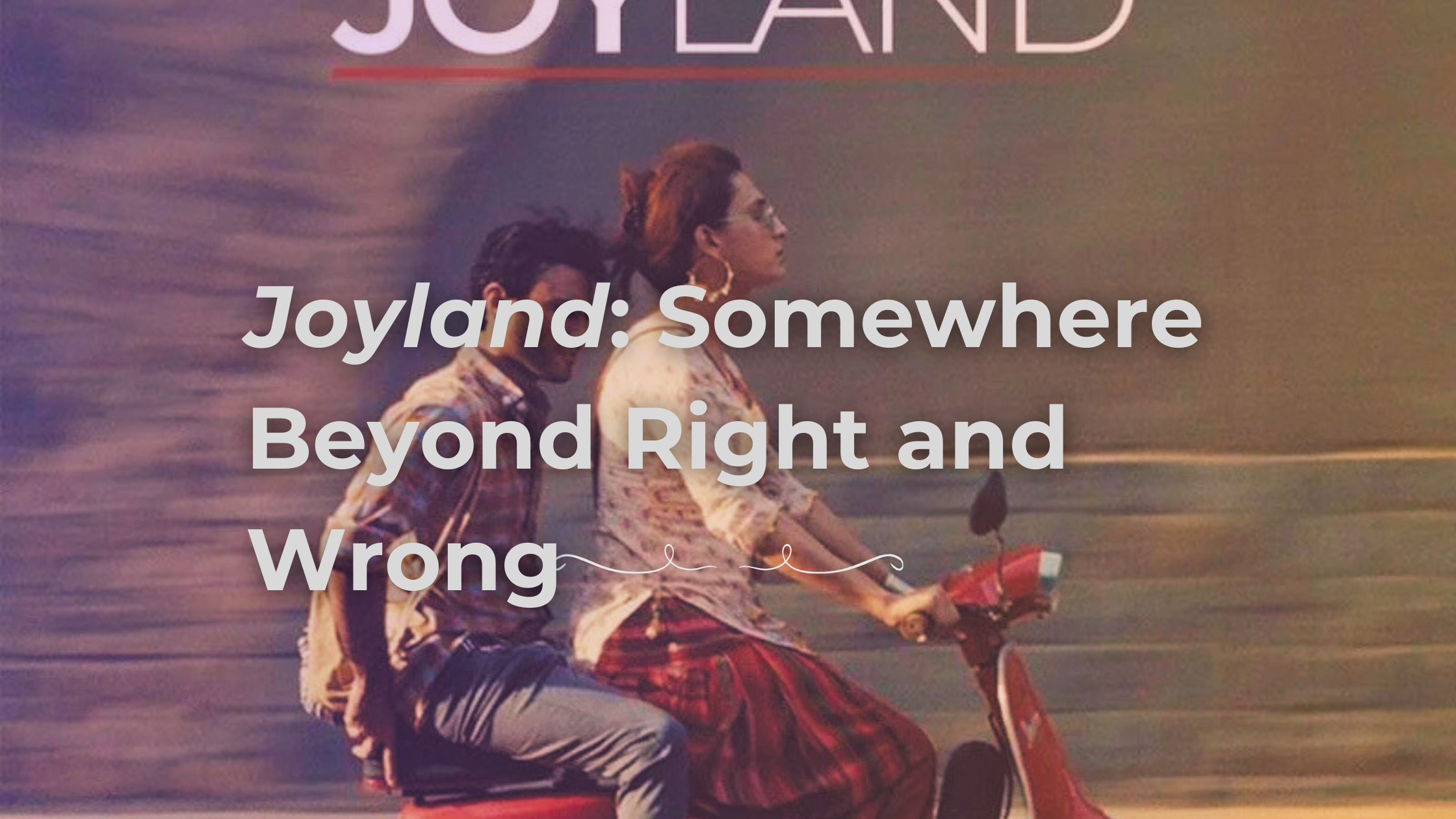
Films have never been mere fodder for entertainment to me. They are instruments of dissent and vessels of history, as every artistic medium should be. Joyland (2022), directed by Saim Sadiq, is a testament to the aforementioned statement. Set in the city of Lahore, depicting the trials and tribulations of a Muslim family and engaging deeply with the notion of gender roles in relation to sexuality, this film is bound to strike a chord in every sensitive heart. This essay is not a review, but rather a commentary that attempts to explicate the nuances of Joyland by venturing beyond the cinematic, with a a particular emphasis on its portrayal of love, its multipolarities, and inherent contradictions. It is a tale that must be revisited time and again, especially in today’s vitriolic socio-political ambience, where diversity is being vehemently rejected by the flagbearers of intolerance.
Amanullah, the elderly patriarch in the film, lives with his two sons, daughters-in-law and granddaughters. He yearns for the birth of a grandson to carry forward his family’s name. The story revolves around Haider, the younger son, and his wife, Mumtaz, while their elder counterparts, Salim and Nucchi, pivotally intervene at opportune junctures. Haider is unemployed. He is shown taking care of household chores, looking after his nieces while Mumtaz works at a salon. He is at the receiving end of his father’s taunts for this, who even expresses doubts regarding his virility.
On the occasion of Eid, Haider is asked to sacrifice the cow ceremonially. Still, he is unable to go ahead with the task. Mumtaz steps in and wields the butcher’s knife in his stead. Hence, a startling inversion of gender roles and the association of masculinity with socially augmented stereotypes is portrayed at the very beginning. Stricken by the lack of respect, a desperate Haider secures a job as a background dancer at an erotic dance theatre. This further deflates his confidence, and he lies about his designation to his father and elder brother. Subsequently, Mumtaz is forced by Amanullah to relinquish her job as Haider starts earning. At the theatre, he meets Biba, a transgender dancer whom he first encountered earlier at the hospital during Nucchi’s delivery.
The story inches on as we encounter the world of erotic dancing intimately, where, in another satirical inversion of gender dynamics, the trans Biba is seen ordering around her troop of male backup dancers. The filmmaker starts alluding to Haider’s sexual orientation at this point (him playing the part of Juliet in a school play). The palpable sexual tension between him and Biba makes Mumtaz somewhat jealous and insecure. Interestingly, we observe Mumtaz claiming not to be threatened by Biba’s increasing importance in her husband’s life because ‘she is not a woman’ per se. Although their conjugal life is depicted as dry and unfulfilling, she banks on her femininity should a tussle arise over Haider’s heart and body. The film masterfully juxtaposes Mumtaz’s frustration at being a housewife and her incessant desire to be out in the world alongside Haider’s evident gender dysphoria. Both of them struggle to come to terms with their societally ascribed roles and embark on a journey of self-discovery.
The film historicises the prevalent conservatism in an orthodox Islamic societal milieu with individuals shackled by multiple taboos. The interdependence between Amanullah and the widow Fayaz, their neighbour, touches upon the very sensitive issue of companionship and loneliness in old age. One night, Nucchi and Mumtaz leave for an entertainment park – ‘Joyland’, which is a metaphor for a place beyond their stifling domesticity. Fayaz stays back to look after the ailing old man. The very next morning, her enraged son arrives and insults the Rana family by insinuating an immoral sexual relationship between Fayaz and Amanullah. Defying her son, Fayaz astonishingly reclaims her agency. He wishes. He wishes to stay back with them, but Amanullah, unable to shake off his rigid normative sense of propriety, asks her to leave. This elucidates how women are ‘owned’ by the marital institution, ordained and preserved by patriarchy, which never relinquishes its firm grip on them.
Meanwhile, Biba and Haider give in to their desires and start a torrid affair. Mumtaz is shown to be pregnant with a boy and suffers gravely from prenatal depression. During a sexual encounter, Haider assumes the ‘receptive posture’which enrages Biba. Haider’s homoeroticism is revealed explicitly, and the raw scene unravels how Biba and Haider’s sexual needs are antithetical. In a moment of frenzy, Biba insults Haider and calls him a ‘faggot’, which reiterates how deep-rooted taboos and binaries morph our world-views. Those who are on the receiving ends of such marginalisation are not exempt from these follies.
Beyond the clamour of overlapping storylines, Mumtaz and Haider’s relationship, apparently lacking in passion and chemistry, takes centre stage. It is evident that they love each other deeply, but both fail to express what they want, and consequently, they suffocate over their choices. Haider’s queerness and Mumtaz’s yearning for independence are two sides of the same coin. Unlike Nucchi, who is a conformist, Mumtaz doesn’t want to be burdened by a baby and tries to leave home. Haider is mainly absent from the domestic scene. On the night of Haider and Biba’s altercation, a severely distressed Haider returns home without his shoes. Mumtaz notices, and the subsequent few frames are clearly indicative of her hunch about the affair. In a poignant scene, they cry in anguish, holding on to each other, miserable in the prison of pre-determined choices.
Mumtaz breaks her cycle of hopelessness in one swift act. The climax, although a rude shock to her family, is foreshadowed throughout the film. While Salim, every bit as insensitive as a heteronormative male patriarch, laments the loss of the male foetus, both Haider and Nucchi are distressed. The loss of love changes something in our diminutive protagonist, who stands up for his late wife and expresses his revulsion towards his family.
The shot pans back to a time before any of this transpired, when Haider went to meet his bride-to-be in secret. He asks her, “Do you want to say yes?” thereby presenting her with a choice to affirm or decline the proposed union. The mind reverts to an intimate scene where the young couple discuss going to the ocean someday. Haider’s inner strife, his carnal longing for Biba and the severance of his deep emotional bond with Mumtaz scar him viscerally. Leaving everything behind, he seeks refuge in the ocean. As we watch him wading through the saltwater, quite akin to Christ, lonesome and forlorn, we are reminded of Rumi’s lines –
‘Somewhere beyond right and wrong, there is a garden/ I’ll meet you there’
The film leaves behind lingering questions on our desires and the transience of identities. It emphasises the urgency for absolute freedom of expression. It never tries to narrativise a preset notion. It delves impeccably into the labyrinth of love, loss and longing vis-à-vis the self.

Saukarya Samad is a Doctoral Candidate at the Department of History, University of Delhi. He’s an alumnus of Presidency University, Kolkata. His broad area of interest lies around the use of alternative/counter-archives (literature, music and films) in reconstructing the past.