Trending


Enter your email address below and subscribe to our newsletter

A Symphony of Memory and Change

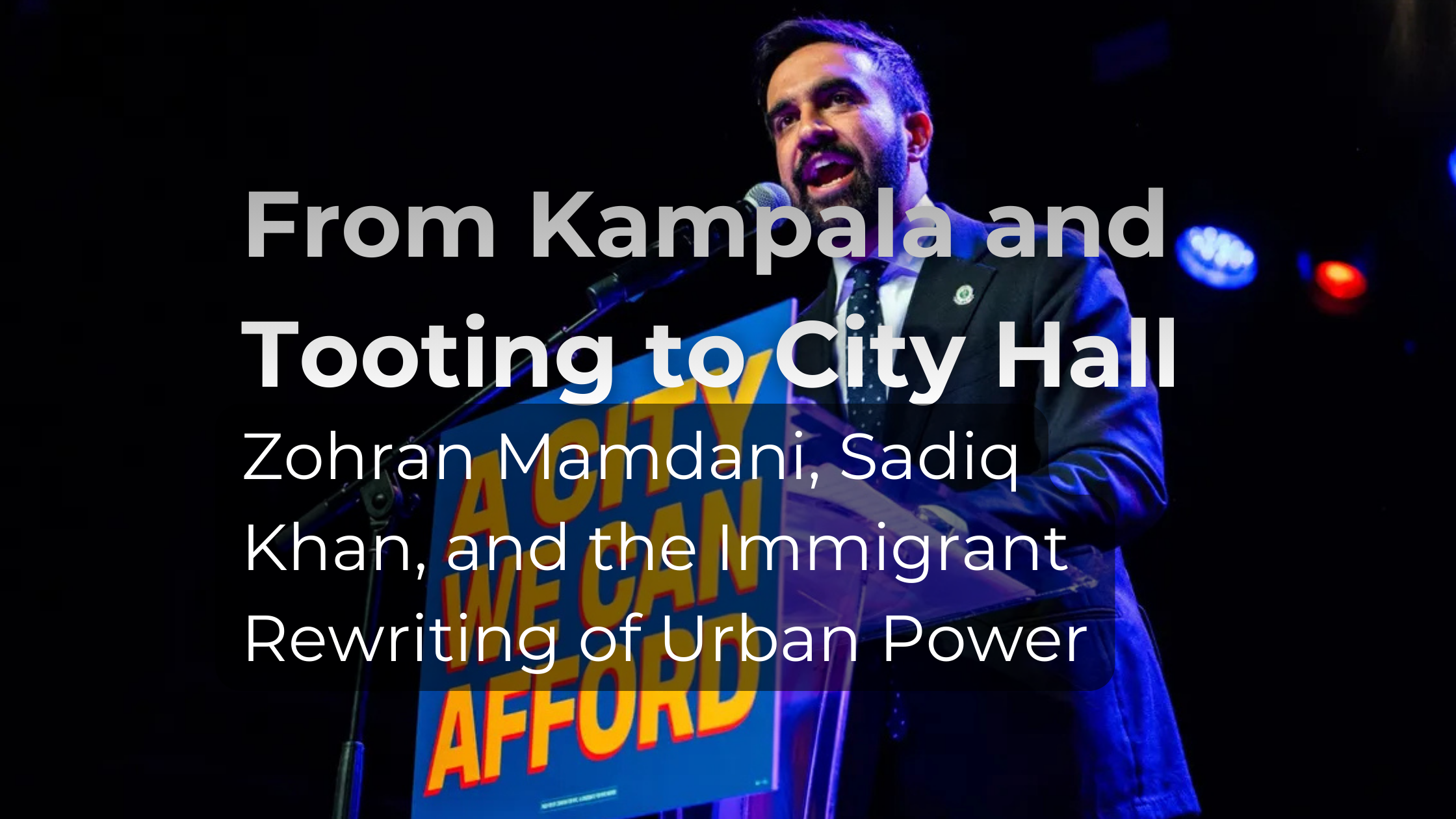
On election night in New York, the story didn’t read like the familiar script. A little-known state lawmaker—young, openly Muslim, and proudly calling himself a democratic socialist—didn’t just squeak through a fractured field. He won. And in doing so, Zohran Mamdani became the ‑mayor-elect of the largest city in the United States, set to take office on January 1, 2026.
New York’s next chapter is now being written by a politician whose biography cuts across borders and whose politics are rooted in the idea that city government should function like a public utility: something that makes daily life doable. On the other side of the Atlantic, London has been living a version of this story for nearly a decade. Sadiq Khan—also a Muslim, also the son of immigrants, and also a product of a sprawling metropolis shaped by migration—has not only held the city’s top job since 2016, but he also won a record third term in 2024.
Different countries. Different parties. Different histories of race, class, and religion.
But the resemblance is real.
Mamdani’s rise and Khan’s longevity reveal something bigger than two men and two elections: the way global cities are becoming laboratories where the children of immigrants—sometimes immigrants themselves—are no longer just “represented.” They’re governing. They’re shaping budgets. Staffing transitions. Rewriting what competence looks like. And doing it inside institutions that, for generations, assumed leadership would look whiter, older, and more socially “standard” than the populations these cities actually serve.
The New York shock: a “little-known” lawmaker becomes the face of a city
Mamdani’s ascent is remarkable even by New York standards, where political careers can be made (and ended) in a single headline. The Associated Press framed his win as a “stunning ascent” from a state legislator to the mayoralty. NPR’s election coverage similarly highlighted how quickly he gained national attention.
However, the story isn’t just about speed. It’s what the speed symbolises.
At the time of his victory, Mamdani was 34—young enough that his political memory is shaped by the post‑9/11 era, the 2008 crash, and the cost-of-living crisis that followed. And he didn’t run as a “generic” Democrat who nods to progressive causes while promising managerial calm. He ran as an explicitly ideological candidate: “a self-described Democratic socialist” and a Muslim.
In New York, that’s not just a personal label. It’s a governing claim. It signals a willingness to address the city’s most significant problems—rent, child care, food prices, and transit—not as private burdens that individuals must absorb, but as collective issues that a city can actively address.
The immigrant biography that isn’t a footnote—it’s the frame
Mamdani’s political identity is inseparable from his geographic one.
According to his official New York State Assembly biography, Mamdani was born and raised in Kampala, Uganda, and moved to New York City with his family at age seven. He went through the NYC public school system, attended the Bronx High School of Science, studied Africana Studies at Bowdoin College, and became a naturalised U.S. citizen in 2018.
This matters for more than symbolism. It’s the lived experience of bureaucracy, paperwork, and the quiet vulnerability of being “in process”—the kind of experience that shapes how a politician thinks about the state. His pre-politics work also fits that arc: before taking office, he worked as a foreclosure prevention housing counsellor, helping low-income homeowners of colour across Queens fight eviction.
In other words, he didn’t just campaign on affordability as an abstract moral principle; he also emphasised its practical implications. He built his résumé inside the machinery of housing insecurity.
That background also clarifies why “from the ranks” is a fair description, even if it’s not the classic rags-to-riches myth. Mamdani’s climb wasn’t a glide path through established citywide offices. It was a leap from neighbourhood-level organising work and a state assembly seat into the most complex municipal job in the country—via a campaign that treated everyday survival costs as the primary political issue.
The platform that made “affordability” feel like a movement
If you want to understand why Mamdani’s rise wasn’t just a fluke, start with the policies he put at the centre of the campaign.
AP reports that his promises included:
and a proposed “Department of Community Safety” that would send mental health workers to handle specific calls rather than police
These are not marginal tweaks. They imply a different philosophy of what city government is for: not simply managing disorder, but lowering the cost of life.
The “public grocery store” idea, in particular, became a kind of shorthand for his politics—bold, practical-sounding, and designed to make a complicated system (food inflation, corporate pricing, rents) feel tangible at street level. A Guardian deep dive on the proposal described how Mamdani argued that municipal stores could lower overhead and pass the savings on to shoppers. They noted the plan’s resonance in polling.
Whether every proposal survives the realities of law, budgets, and Albany politics is another question. But as electoral messaging, the platform did something essential: it made government feel like it could do something again.
The coalition: youth energy, new voters, and the digital field operation
A second pillar of Mamdani’s rise was the appearance and composition of his coalition.
Research from Tufts’ Centre for Information & Research on Civic Learning and Engagement (CIRCLE) highlighted youth turnout and youth support as defining features of the 2025 race, reporting an estimated 28% youth voter turnout and strong youth backing for Mamdani.
That’s not just “young people showed up.” It’s a structural story: city elections typically suffer from low turnout, and youth participation is often the first thing to collapse when politics feels irrelevant. A campaign that reverses that trend is doing more than winning; it’s expanding the electorate that future politicians must answer to.
This is where the Mamdani‑Khan comparison begins to sharpen, because both men are urban politicians who understood something older politicians sometimes miss: big-city governance isn’t only about policy details. It’s about legitimacy—about convincing residents that the city belongs to them, even if they don’t feel it does.
The controversy factor: governing is harder than campaigning
A deep dive can’t ignore what Mamdani’s win also triggered: intensified scrutiny of his record, his rhetoric, and his ability to convert big promises into funded programs.
AP notes that he was criticised during the campaign for having a “thin résumé,” and that questions remain about how he would pay for expansive initiatives—especially given the political realities of state-level tax policy.
There’s also the matter of public safety and policing. AP reports that Mamdani was a fierce critic of the NYPD in 2020, later apologised for some of his comments, and said he would ask the current commissioner to stay on. Those details hint at the tightrope ahead: he will be expected to deliver reform-minded changes while also managing a city where public safety debates are rarely patient or nuanced.
And then there’s foreign policy spillover—especially Gaza. AP reports that Cuomo and others attacked Mamdani for his criticism of Israel’s military actions, and that Mamdani has accused Israel of committing genocide and said he would honour an ICC warrant for Benjamin Netanyahu. Even if mayors don’t control foreign policy, city politics in 2025 clearly don’t respect that boundary.
This isn’t a detour from the “phenomenal rise” story. It’s the price of the rise: the larger the symbolic meaning attached to a candidate, the more every issue becomes a referendum on that symbol.
Enter London: Sadiq Khan’s long road from council estate to City Hall
If Mamdani’s story is about rapid ascent, Sadiq Khan’s story is about staying power—and what it takes for an immigrant-background politician to survive not one election but a series of them.
London’s official mayoral biography describes Khan as the son of immigrants from Pakistan, raised on a council estate in south London, the first in his family to go to university, and a former human rights lawyer before entering Parliament. Reuters’ 2016 coverage, when Khan first won, emphasised the same frame: “the son of a bus driver” who became London’s first Muslim mayor after a campaign in which opponents tried to link him to extremism.
Khan’s trajectory is almost archetypal in British political terms: working-class roots, a legal career, an MP, and then a mayor. But what makes it historically significant is that it happened in a country where Muslim political identity has frequently been treated as suspect, conditional, or “other.”
And unlike a symbolic one-off, Khan’s tenure has been renewed: an Institute for Government explainer notes that on May 2, 2024, he was re-elected mayor with 44% of the vote, and that the role oversees a budget of over £20 billion through the Greater London Authority. AP likewise reported his record third-term victory in 2024.
In other words, Khan isn’t simply a milestone in representation. He’s a durable governing figure in one of the world’s most scrutinised cities.
1) Both are Muslim leaders in cities that define “the West”
Khan was widely described as the first Muslim mayor of a significant Western capital when elected in 2016. Mamdani is on track to become New York City’s first Muslim mayor when he takes office in 2026.
This matters because major Western capitals are not only administrative units—they are also cultural signals. They export norms, not just policies. A Muslim leader in these posts shifts what “normal” looks like, especially for young Muslims who have grown up seeing their faith discussed primarily through security frames and suspicion.
2) Both rose by making “cost of living” feel like a moral emergency
Mamdani’s platform was explicitly “laser-focused” on affordability, in the Guardian’s phrasing, proposing policies like free childcare, a rent freeze, and public groceries.
Khan’s policy terrain is different—London’s mayor has distinct powers and constraints—but his political endurance has also been tied to bread-and-butter city questions: transport, housing, air quality, and affordability. The Institute for Government explainer underlines that the London mayor oversees transport and significant spending capacity through the GLA.
In both cases, their politics isn’t only “identity politics.” It’s governance politics—built around what it costs to live in a global city.
3) Both have had to govern under national pressure and hostile narratives
For Khan, the hostile narrative has long included accusations of extremism-by-association; Reuters explicitly referenced how his 2016 opponent tried to link him to extremism.
For Mamdani, pressure comes from a different direction: the American right’s reflexive “socialist” panic, and the way New York becomes a proxy for national culture wars. AP notes that his critics attacked him on policing and his stance on Gaza, and that his policies are seen by opponents as polarising.
The connective tissue isn’t that their critics are “the same.” It’s that being a Muslim mayor in a high-profile Western city often means your legitimacy is contested at a level that goes beyond ordinary partisan disagreement.
One striking recent link between their worlds: Reuters reported that UK Prime Minister Keir Starmer’s government defended Khan after renewed criticism from Donald Trump, and that Khan congratulated Mamdani on becoming New York’s first Muslim mayor, explicitly celebrating the milestone.
That’s not just a feel-good moment. It’s an emerging transatlantic solidarity of municipal leaders who understand they’re often fighting on two fronts: local policy and symbolic legitimacy.
“Dominantly white world” vs. the actual demographics of global cities
There’s a provocative claim in the prompt: that immigrant sons and daughters are “taking up key policy positions in the dominantly white world.”
Here’s the twist: New York and London—the two cities at the centre of this story—are not “dominantly white” in population terms. They’re among the most diverse cities on Earth.
New York City’s immigrant population was reported at 3.1 million people—about 38% of the city—in 2022, according to NYC’s Mayor’s Office of Immigrant Affairs.
U.S. Census QuickFacts lists NYC as about 31.3% White (non-Hispanic) and 36.5% foreign-born (2019–2023 estimates).
A Reuters fact-check citing the 2021 England and Wales Census put London’s foreign-born share at 40.6%.
London Datastore notes that, at the 2021 Census, only 37% of Londoners identified as White British—meaning most Londoners identify as something else (including other White groups and minority ethnic groups).
So what’s “dominantly white” here?
Not the cities. The institutions that historically controlled prestige and policy: national political leadership, senior civil service, major media gatekeeping, corporate boards, and the inherited stereotypes of who looks “mayoral.” Those institutions often lag behind demographic reality.
That lag is why Mamdani and Khan feel so resonant even inside two majority-diverse cities. Their elections are not simply “the cities reflecting themselves.” They are the cities forcing older power structures—inside and outside city boundaries—to acknowledge the world as it now is.
The immigrant pipeline: from “community” to “governance”
One of the most under-discussed parts of Mamdani’s win is what happens next: staffing.
AP reports that he will have to begin staffing his incoming administration and figuring out how to translate an ambitious agenda into implementable policy.
That staffing piece is where immigrant sons and daughters often “arrive” in a new way: not as candidates on posters, but as deputy mayors, commissioners, policy directors, budget analysts, and agency heads—the people who write the rules that define daily life.
Mamdani’s story is already showing how quickly that pipeline can open. His transition website describes raising funds rapidly, launching a résumé portal, and appointing leadership for the transition—signalling an effort to recruit talent and build governing capacity rapidly.
In London, Khan’s long tenure has meant something similar: a sustained shaping of city agencies and priorities across multiple terms—meaning the policies associated with his worldview (transport, environmental regulation, city planning) are not a one-off experiment but a continued administrative project.
What this moment means—and what it doesn’t
It’s tempting to reduce Mamdani and Khan to symbols: “the Muslim mayor,” “the immigrant mayor,” “the socialist,” “the Labour man.”
But symbols don’t balance budgets. They don’t negotiate with unions. They don’t manage crises. And they don’t fix housing markets that have been distorted for decades.
The more profound lesson in both stories is more practical:
Global cities are now electoral coalitions of renters, immigrants, and young people. When those groups organise, they can win—even against legacy power.
Affordability has become the master issue, as it affects everything: where you live, how you commute, whether you can have children, and whether you can stay in the city where you grew up.
Faith and identity aren’t separate from governance in the modern city. They shape trust. They shape who gets listened to. And they shape who gets attacked.
In that sense, Mamdani’s rise and Khan’s endurance are not just parallel stories—they’re sequential chapters in the same global narrative: the children of migration claiming not only a seat at the table, but the authority to redesign the table itself.
Dr. Sabarna Roy is a decorated, critically acclaimed, and bestselling author of 12 literary works and 3 technical works. He is the Chief Technology Officer at an Iron & Steel Company in Kolkata.