Trending

Current Read





Enter your email address below and subscribe to our newsletter

A Symphony of Memory and Change

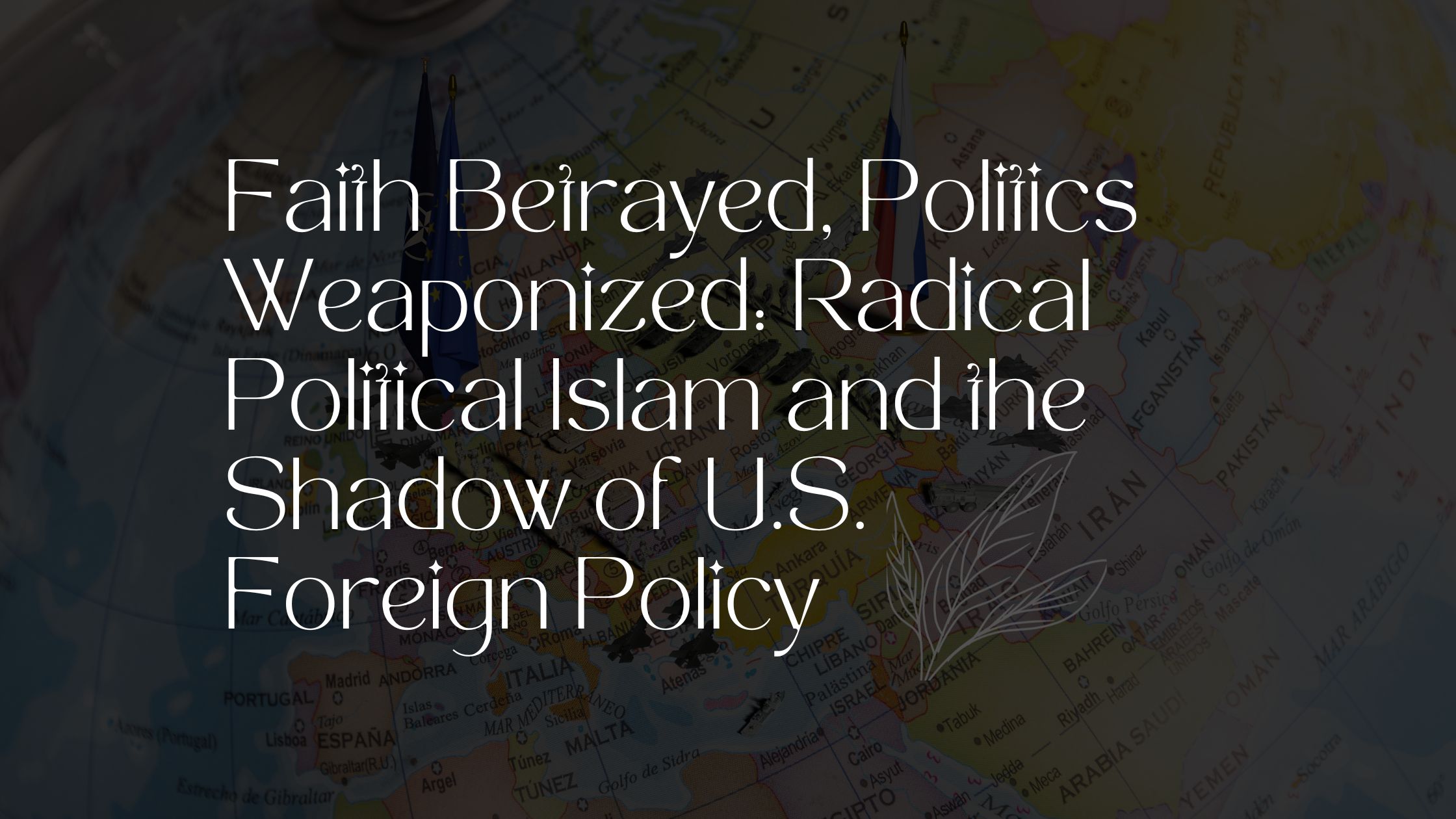
The divide between Islam as a personal faith and Radical Political Islam as a geopolitical force is one of the defining tensions of the modern Muslim world. Islam—spanning over 1,400 years of theological depth and spiritual pluralism—is not inherently political or militant. But over the last century, it has been co-opted by ideologues and weaponized by state actors, including the United States, Saudi Arabia, and even some factions within Iran and Israel. The rise of Radical Political Islam cannot be disentangled from Cold War strategy, the post-colonial vacuum, petro-financial arrangements, sectarian rivalries, and the calculated decisions of global powers.
What follows is a deep dive into this ideological evolution, alongside an annotated timeline to trace key turning points that shaped this turbulent narrative.
I. The End of Empire and the Birth of an Idea
1924 – Abolition of the Ottoman Caliphate
Mustafa Kemal Atatürk dissolves the last symbolic unifier of the Muslim world. This event creates a profound identity vacuum in Sunni Islam and spurs the rise of Islamist thinkers seeking to restore religious authority through political structures.
In response, Hassan al-Banna (Egypt, 1928) and Abul A’la Maududi (South Asia, 1941) found the Muslim Brotherhood and Jamaat-e-Islami, advocating Islam as a total system of governance. These movements are not yet violent but lay the ideological foundation for future radicalism by linking divine sovereignty with state power.
II. Iran’s Revolution and the Shia Islamist Model
1979 – Iranian Revolution
The Shah of Iran, a U.S.-backed monarch, is overthrown. Ayatollah Khomeini establishes a Shia theocracy—the Islamic Republic of Iran—based on Vilayat-e-Faqih (guardianship of the jurist).
Iran redefines Islamist politics from a Shia perspective, offering a radical countermodel to Sunni groups. It supports Hezbollah, backs Shia militias across the Middle East, and openly challenges both the U.S. and Saudi Arabia. This sectarian fault line soon becomes militarized in regional conflicts—from Lebanon to Iraq and Yemen.
III. Cold War Alchemy: How Washington Funded the Jihad 1979 – Soviet Invasion of Afghanistan
The Cold War enters the Islamic world. The U.S., under Operation Cyclone, funnels over $3 billion in arms and aid to Afghan mujahideen via Pakistan’s ISI, in a bid to “bleed” the Soviets.
Among the beneficiaries are hardline Islamists like Gulbuddin Hekmatyar and Osama bin Laden, whose Maktab al-Khidamat later evolves into Al-Qaeda. Meanwhile, Saudi Arabia, aligned with U.S. interests, pumps billions into Wahhabi madrassas that radicalize youth from across the Muslim world.
IV. The Petrodollar Pact and the Export of Wahhabism
1974–1980s – Petrodollar Agreement Between U.S. and Saudi Arabia
The U.S. and Saudi Arabia strike a deal: Saudi oil must be sold in U.S. dollars, securing dollar supremacy. In return, U.S. arms and protection flood into Riyadh.
With vast surpluses, Saudi Arabia launches a global Islamic “revival”, funding Wahhabi mosques and madrassas from Indonesia to Nigeria. Though intended as soft power, these institutions often propagate intolerant, anti-pluralistic ideologies. The fusion of financial power and religious absolutism becomes a key engine of Radical Political Islam’s expansion.
V. The Ideological Weapon: Qutbism and Takfirism
1966 – Execution of Sayyid Qutb
Qutb’s vision of Islam as a revolutionary force—hostile to secularism, democracy, and modernity—gains posthumous traction. His concept of jahiliyya redefines all non-Islamist societies as heretical, and his call for a vanguard of revolutionaries becomes the doctrinal core of Al-Qaeda and later ISIS.
Takfirism, the excommunication of fellow Muslims, becomes a deadly tool: now, even Muslims who disagree with radical ideology are legitimate targets.
VI. The Blowback: From Proxy Fighters to Global Threats 1989 – Soviet Withdrawal from Afghanistan
The West declares victory, but the jihadists it armed now turn inward and outward. Bin Laden breaks from Saudi elites and U.S. handlers to form Al-Qaeda, targeting the “far enemy” (the U.S.) for its presence in Muslim lands.
1996 – Al-Qaeda’s Declaration of War Against the U.S.
The seeds of 9/11 are sown. Bin Laden denounces U.S. support for Israel and Arab autocracies, especially the Saudi monarchy. For many, Israel’s continued occupation of Palestine and the U.S.’s uncritical military and diplomatic support becomes a rallying cry for jihadist recruitment.
VII. 9/11 and the American Reckoning
2001 – September 11 Attacks
Coordinated by Al-Qaeda, the attacks kill 3,000 in the U.S., triggering the “War on Terror.” American forces invade Afghanistan and, in 2003, Iraq—despite no proven link to 9/11.
This military overreach leads to state collapse, insurgency, and sectarian violence. The disbanding of the Iraqi army and marginalization of Sunnis pave the way for ISIS to emerge from Al-Qaeda’s remnants.
VIII. Israel, Hamas, and the Perpetual Fire
The ongoing Israeli-Palestinian conflict further radicalizes discourse. Groups like Hamas—born out of the Muslim Brotherhood—gain credibility among Palestinians through social services and resistance, while their attacks on Israeli civilians draw harsh reprisals.
U.S. military aid to Israel, combined with diplomatic shielding at the UN, contributes to the perception among many Muslims that American foreign policy is not just biased but complicit in Muslim oppression. Radical groups like Al-Qaeda and ISIS use images of bombed Gazan children and demolished mosques as recruitment propaganda.
IX. The Caliphate Reimagined: ISIS and Sectarian Chaos
2014 – ISIS Declares a Caliphate in Mosul
Led by Abu Bakr al-Baghdadi, ISIS captures territory across Iraq and Syria. It enforces a brutal version of Sharia, destroys heritage sites, and conducts genocide against Yazidis.
Iran and Saudi Arabia become rival power brokers in the anti-ISIS coalition, backing opposite factions. U.S. drone warfare, Iranian militias, and Russian airpower finally dislodge ISIS territorially by 2019, but the ideological infrastructure remains.
X. Present Status: Diminished, but Not Dead
Radical Political Islam is fractured. ISIS is stateless, Al-Qaeda is fragmented, and the Taliban’s return in Afghanistan reveals more pragmatism than apocalyptic zeal. But underlying drivers remain: authoritarian repression, economic inequality, unresolved occupation, and sectarian division.
Meanwhile, U.S. and Israeli policies continue to feed perceptions of injustice, even as Iran and Saudi Arabia manipulate sectarianism for geopolitical ends.
Conclusion: A Century of Crossed Wires
Radical Political Islam did not arise from Islam the faith—it was born from a confluence of imperial collapse, Cold War tactics, petro-dollar diplomacy, and sectarian manipulation. The U.S. helped arm its enemies. Saudi Arabia exported ideology it no longer controls. Iran injected militancy into Shia identity. Israel’s unresolved conflict remains a wound that bleeds into every narrative.
In contrast, the heart of Islam—its poetry, jurisprudence, philosophy, and mysticism—survives beneath the rubble. To defeat radicalism is not merely a matter of drone strikes or surveillance, but of reclaiming the spiritual and moral essence of Islam from the clutches of geopolitics.

Sabarna Roy was Senior Vice President [Business Development] at Electrosteel Castings Limited and he was the DI Business Head: Sales & Marketing at The Sandur Manganese and Iron Ores Limited at their Corporate Office in Bangalore, and presently he is the Head [Research & Development] at Kejriwal Castings Limited at their Corporate Office in Kolkata, and an author of ten Literary and three Technical critically-acclaimed bestselling books, TEDx Speaker, Champions of Change Award 2020 Winner, Times Excellence Award 2021 Winner in Indian Literature, and Golden Glory Award Winner for Critically Acclaimed Bestselling Author of the Year 2021. Sabarna Roy has been awarded the Right Choice Awards for Author of Eminence 2022.